
Reading Time : 6 minutes
Introduction
WhatsApp marketing has become one of the most powerful tools for local businesses. With open rates often exceeding 90%, businesses increasingly rely on WhatsApp broadcast strategies to communicate with customers, promote offers, and maintain engagement.
However, many businesses struggle with declining engagement because they send promotional messages without a clear communication strategy. Understanding how to use WhatsApp broadcast for business effectively can make the difference between ignored promotions and consistent customer interaction.
This guide explains how local businesses can improve WhatsApp customer engagement through predictable messaging rhythms, responsible broadcast practices, and smarter messaging strategies.
In This Article
• Why WhatsApp marketing works for local businesses
• Why random WhatsApp broadcasts reduce engagement
• Meta’s messaging limits and frequency capping
• Risks of unauthorized messaging tools
• Case study: How a local bakery improved engagement
• The ideal WhatsApp broadcast strategy for small businesses
When WhatsApp Promotions Start Getting Ignored
WhatsApp is increasingly becoming a key channel for conversational marketing, allowing businesses to interact with customers in real time. For many local businesses today, WhatsApp has quietly become one of their most powerful customer communication channels.
Ravi runs a small neighborhood bakery where most customers discover new cakes and weekend specials through WhatsApp. Customers regularly use the platform to place orders, ask about custom cakes, and confirm delivery details.
Seeing how responsive customers were, Ravi began sending WhatsApp broadcast messages whenever he had an offer or announcement. Sometimes he sent several promotional messages in a single week, while other weeks passed without any updates.
Initially, customers responded quickly and engagement was strong. Over time, however, Ravi noticed a decline in interaction. Replies became less frequent, some customers stopped opening messages regularly, and a few muted the conversation entirely.
Ravi assumed the issue was the offers themselves. In reality, the problem was not the message content but the messaging pattern. What Ravi discovered later highlights an important lesson for businesses learning WhatsApp marketing best practices.
The Real Power of WhatsApp Marketing for Local Businesses
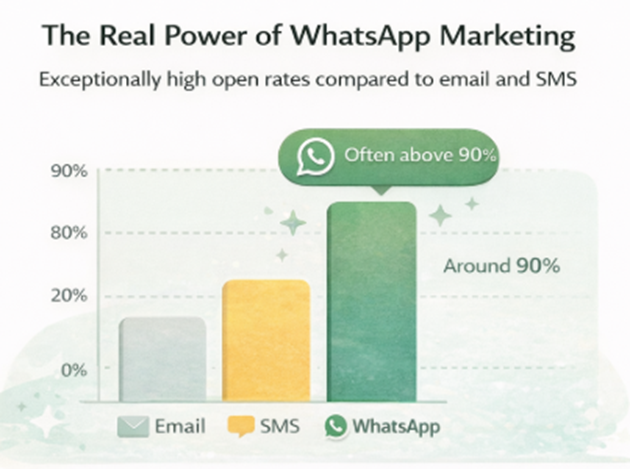
Compared to most digital marketing channels, WhatsApp offers exceptionally high visibility. Messages typically reach users instantly and are often opened within minutes.
Industry benchmarks show that WhatsApp messages often achieve open rates above 90%, significantly higher than email marketing.
Channel Average Open Rate | Average Open Rate |
20-30% | |
SMS | Around 90% |
Often above 90% |
This level of engagement makes WhatsApp one of the most effective tools for customer communication and messaging marketing strategies.
Businesses across industries rely on WhatsApp Business for:
• customer support
• order confirmations
• product updates
• promotional announcements
However, the same visibility that makes WhatsApp powerful also creates a challenge. Customers immediately notice when businesses send too many messages or irregular promotions.
Why Random WhatsApp Broadcasting Reduces Engagement
Research on digital communication behavior shows that predictable messaging patterns increase user trust and engagement.
When customers receive updates at consistent intervals, they begin to recognize and expect communication from a business. Random messaging produces the opposite effect.
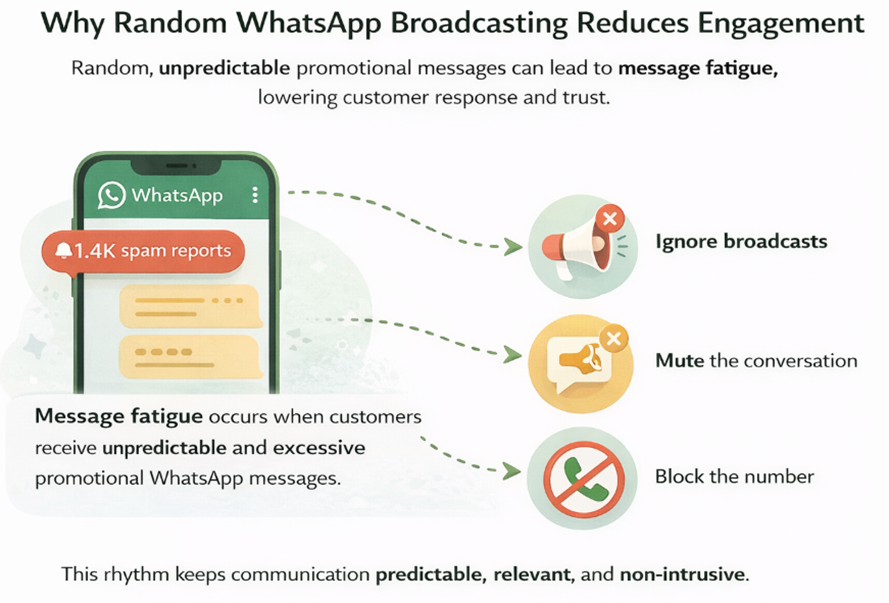
Each unexpected message forces the recipient to decide whether it is useful or simply another promotion. Over time, this repeated decision-making creates message fatigue.
When message fatigue occurs, customers may:
• ignore promotional broadcasts
• mute business conversations
• block the business number
Because WhatsApp is primarily used for personal communication, businesses must follow responsible WhatsApp broadcast best practices.
Meta’s Frequency Capping: Why Sending More Messages Can Reduce Reach
Many businesses assume that sending more broadcast messages will increase visibility. In reality, messaging platforms implement safeguards to protect users from excessive promotional communication.
Meta uses a system called frequency capping, which limits how many marketing messages a user can receive within a certain timeframe.
Importantly, this limit is applied per user across all businesses, not per individual company.
Customers may already receive promotional messages from:
• restaurants
• retail stores
• delivery services
• local service providers
If a user receives too many promotional messages, additional broadcasts may not be delivered. Excessive messaging can therefore reduce visibility instead of improving it.
WhatsApp’s Quality Rating System
WhatsApp also evaluates the quality of messages sent by business accounts.
Meta assigns each WhatsApp Business account a quality rating based on user feedback and engagement patterns.
Accounts are typically categorized as:
• High quality
• Medium quality
• Low quality
This rating is influenced by signals such as:
• customers blocking the business number
• messages reported as spam
• very low engagement with broadcasts
Businesses with declining message quality may face:
• reduced messaging limits
• broadcast delivery issues
• temporary messaging blocks
In severe cases, numbers may face permanent restrictions.
The Risk of Unauthorized Bulk Messaging Tools
Some businesses attempt to scale messaging using unofficial bulk messaging software that promises unlimited broadcasts.
However, many of these tools operate outside the official WhatsApp Business API infrastructure.
Using unauthorized messaging providers can lead to serious consequences including:
• temporary messaging restrictions
• account suspension
• permanent number blocking
For local businesses that depend on WhatsApp for orders and communication, losing access to a number can disrupt customer relationships.
A Real Example: When a Business Lost Its WhatsApp Number
A uniform manufacturing business once attempted to expand its outreach by sending large numbers of promotional messages through WhatsApp.
Instead of using official WhatsApp Business tools, the owner relied on a third-party messaging provider.
Initially, the system allowed hundreds of messages to be sent within minutes. However, several recipients marked the messages as spam, triggering platform compliance checks.
Within a short period, the business number was blocked.
Because the number had been used for years to communicate with schools, distributors, and clients, the company had to start over with a new number and rebuild customer relationships.
The Strategy That Turned WhatsApp into a Growth Channel
While some businesses struggled with messaging issues, Ravi adopted a structured communication approach.
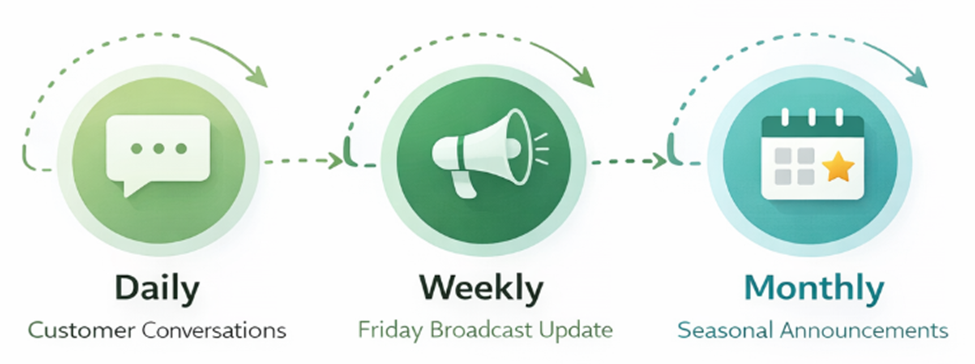
Daily: Customer Conversations
WhatsApp became the bakery’s primary customer support channel. Ravi focused on responding quickly to inquiries, confirming cake orders, and sharing delivery updates.
Weekly: Friday Broadcast Update
Every Friday evening, Ravi sent one broadcast message highlighting weekend specials and reminding customers to place pre-orders.
Monthly: Seasonal Announcements
Once a month, Ravi shared broader updates such as festival cake collections and new menu additions.
The Results of Structured WhatsApp Broadcasting
Within weeks, Ravi noticed clear improvements.
• customer replies increased
• weekend orders grew consistently
• engagement improved across the broadcast list
Customers began anticipating the weekly update, turning the broadcast into a useful and expected communication.
The Ideal WhatsApp Broadcast Strategy for Local Businesses
Frequency | Purpose |
Daily | Customer support and inquiries |
Weekly | Offers and product updates |
Monthly | Major announcements |
This rhythm keeps communication predictable, relevant, and non-intrusive.
Predictability Builds Customer Trust
Behavioral research shows predictable communication reduces cognitive load for users.
When customers recognize consistent messaging patterns, they associate messages with useful information. This increases the likelihood that broadcasts will be:
• opened
• read
• acted upon
Random communication weakens engagement because customers cannot anticipate the value of incoming messages.
Key Insight for Local Businesses
WhatsApp works best as a relationship-driven communication channel rather than a mass advertising platform.
Businesses that maintain a clear messaging rhythm often achieve:
• higher engagement
• stronger customer trust
• better message visibility
• healthier account quality ratings
For small businesses today, the challenge is no longer reaching customers. It is communicating in a way that respects attention while maintaining visibility.
Final Takeaway
For local businesses, WhatsApp broadcasting is more than a marketing tactic. It is a direct customer relationship channel that can strengthen trust and drive repeat business.
Businesses that focus on consistent, relevant, and well-timed communication can transform WhatsApp into one of their most effective growth tools.
The difference is not how many messages businesses send.
It is how thoughtfully they send them.
Related Resources on WhatsApp Marketing
If you're exploring ways to improve customer engagement through messaging platforms, these guides can help you deepen your WhatsApp marketing strategy:
• Getting Started : https://www.memorly.ai/blog/whatsapp-broadcasting-training-9/getting-started-with-whatsapp-broadcasting-50
• Optimizing Whatsapp Business : https://www.memorly.ai/blog/whatsapp-broadcasting-training-9/how-to-optimize-whatsapp-business-for-trust-and-customer-conversions-52
• Whatsapp Templates Guide : https://www.memorly.ai/blog/whatsapp-broadcasting-training-9/the-ultimate-guide-for-the-whatsapp-broadcast-templates-54
These resources can help businesses understand how messaging-first communication strategies are transforming customer relationships and digital marketing.
Frequently Asked Questions
1. What is a WhatsApp broadcast and how does it work for businesses?
A WhatsApp broadcast allows businesses to send a single message to multiple customers individually without creating a group chat.
2. How often should businesses send WhatsApp broadcast messages?
Most businesses achieve better engagement by sending broadcasts once a week while responding to customers daily.
3. Can customers see other recipients in a WhatsApp broadcast message?
No, broadcast messages are delivered privately, so recipients cannot see other customers on the list.
4. Why do some customers stop responding to WhatsApp promotions?
Customers often ignore broadcasts when messages are too frequent, irrelevant, or sent without a consistent schedule.
5. Can WhatsApp block a business account for sending too many messages?
Yes, businesses may face restrictions if customers report messages as spam or if messaging violates WhatsApp policies.